Review: The Girl on the Train by Paula Hawkins

Phew! That was a bit of a whirlwind read, I haven’t read a paperback that fast in months, especially when I’m not even on holiday.

I’m a bit late to the party with this one, but if you haven’t read The Girl on the Train yet, here’s my little review. It’s a tense, twisty roller coaster of a book where no one comes out unscathed, and I loved it! I went in knowing relatively little, I wanted to read the book before watching the film, so if you want to avoid knowing too much, don’t read on. I try not to include spoilers, but this is one book where you’re best off starting with absolutely no idea what will happen.

If spoilers don’t scare you, read on!
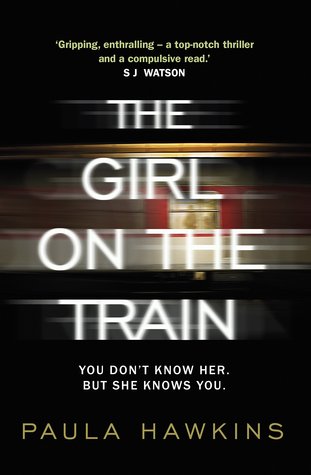
the-girl-on-the-train

4 stars

In a nutshell, Rachel takes the same train into London at 8:04am every morning, and back to Ashbury every evening where she rents a room from an old friend. On the way she passes Witney station, and the house she used to share with her ex-husband before their divorce, two years ago.

The train usually stops at a signal, allowing Rachel to spend a few minutes looking into the back gardens of the houses by the tracks, including her old home. A few doors down, a young, attractive couple are often sitting on their roof terrace or patio drinking coffee, and Rachel likes to imagine who they are and what they might do for work, etc. One day, she sees the wife with another man, and a few days later she sees an article in a newspaper stating that the woman has been reported missing. Feeling like she knows these people after months of watching them from the train window, and knowing that suspicion usually falls on the husband when a woman goes missing, she decides to tell the police and the husband that his wife was having an affair.

The thing is, Rachel is an alcoholic. And she’s been harassing her ex-husband and his new wife for over a year. When Anna, the new Mrs Watson, sees Rachel on the day of the missing woman’s disappearance, she reports it to the police, and as a result Rachel becomes embroiled in the investigation. Suffering from blackouts caused by her heavy drinking, Rachel remembers being outside her old home on that night, she remembers an argument and having blood on her hands, but nothing else.

pink divider

I’ll leave it at that for fear of giving too much away, but suffice it to say this was a book filled with twists and turns, an unreliable narrator who can’t remember crucial events, and a supporting cast of very flawed, complex characters, none of which are completely innocent.

I’m giving it four stars because I really enjoyed it, I was gripped and got through it quite quickly, but there were some slightly frustrating parts. It wasn’t a completely satisfying read for this reason. I feel like the climax could have been even more tense and exciting as the whole book built up towards it and I was so ready to find out what really happened by the end.

I really enjoyed the writing style, it’s written almost like diary entries from the points of view of Rachel, Anna (Rachel’s ex’s new wife) and the woman who is missing, herself. We see the day-to-day run up to ‘that night’ and the aftermath from Rachel, with the occasional counter from Anna, and the events that lead up to it over the course of the last year from the missing woman.

I loved seeing the story from all three sides, each woman was completely different – they were all such fully formed and layered characters, each with their own traits and flaws. Hawkins is a brilliant writer, the story is well crafted, and I found the pacing was just slow enough for me to be desperate for more every time I read, but satisfied with what I had discovered so far.

If you like a good thriller, you’ll love The Girl on the Train. Even if you saw the film and weren’t convinced, I’ve heard it’s nowhere as good as the book and that they changed a few things – I’ll have to watch it now to compare!

Go and get the book, and let me know what you think in the comments below.

Lyndsey

x

PS. Paula Hawkins has a new book coming out soon, Into the Water, and it sounds just as suspenseful and thrilling as The Girl on the Train!

I am a member of the Book Depository affiliate program, so if you click through and buy any of the books mentioned in this blog I might make a little commission, but I am not paid to review books and all reviews are my own opinions!
The Girl on the Train Review.png

Currently Reading:

Paperback

The Shadow Queen by C.J. Redwine

I just started reading this last night and only managed the prologue so far as I was really tired, but I love a good fairy tale retelling so I’m anticipating enjoying this one. I ran a Twitter poll to see what I should pick up next and this won so there are lots of you out there who loved it!

Audiobook

The Scorpio Races by Maggie Stiefvater

I am so in love with this book! I’ve enjoyed everything by Ms. Stiefvater that I’ve read so far, I’ve got The Raven Boys lined up on Audible next and I know that’s most people’s favourite of her series, so I’m really excited to get stuck in, especially after loving this one. The voice actors who play Puck and Sean are absolutely fantastic, they really bring the characters and the whole world she has created to life. I’ll do a review of this when I’m finished as it’s a standalone and I honestly can’t praise it enough!

Second draft word count: 11,066

(I’m about 1/7th through my second draft and it’s going really well so far, keep your fingers crossed for me! I’m writing a post about second drafts so I’ll be sharing that soon.)

Writing romance

Love affects all of us, it’s one of the themes that is universal to almost every single genre. Whether it’s a parent’s love in children’s lit, first love in YA, or the Fifty Shades kind, love is everywhere you look in literature.

As it’s Valentine’s Day, I thought I’d take a look at what makes a really good romance in writing. As my genre is YA, I’m going to stick to what I know – these tips are for romance as a subplot rather than the main focus of your novel, although they could be adapted however you please.

Scroll on, intrepid reader!


romance-in-ya

Know your audience

The accepted age-range for Young Adult seems to be 12-18 years old, which is pretty broad when it comes to experience, if you think about it. An eighteen year old might enjoy the odd steamy scene in their novels, but younger teens are probably not looking for too much steam. (Or maybe they are, but their parents would prefer not!)

On the other hand, teenagers have a lot of hormones pumping through their bloodstreams, and almost every teen has had a crush or a relationship at one time or another. They think about sex, talk about it with their friends, but they’re not all necessarily doing it.

Personally, I don’t mind sex in YA. I think there is a line though and some authors cross into New Adult territory at times. For me, first times and learning about sexuality are completely normal subjects for YA books to cover. Graphic scenes that border on erotica are better left to adult novels, in my opinion. But, it’s up to you. Do what feels right for your novel and your characters, and you can’t go wrong.

The Friend Zone

Nowadays, it seems that being in the “friend zone” has become a bad thing. Personally, I have to disagree. I absolutely love friendships that become more, it’s the best way to find your soulmate and the person you want to spend the rest of your life with. If you can’t even be friends, how can you be partners?

For teens, I think the most common way of starting a relationship is to be friends first. A lot of people go through years of school together and don’t start dating until they’ve known each other for a really long time. They have things in common, have grown up together and spend time together in groups of friends as well as alone.

Some authors forget this fact, and tend to omit the friendship side of the relationship in their books. Yes, it might add to the word count and not technically be essential to the plot, but readers need to see relationships where the two people involved enjoy each other’s company. It’s our responsibility to show young readers how life and love can and should be (ignoring the fantastical elements, those are just fun embellishments). It’s not all angst, flirtatious looks and sex – people actually talk sometimes, and those can be some of the best bits.

Three’s a crowd

Ah, the old-fashioned love triangle. Some readers love them, some hate them. They have become a pretty overused trope in literature, and are not actually very common in real life. (Are they? Am I missing out? I don’t think so…)

There is still a market for books with love triangles (hence why so many have them), but I would encourage you to make yours a little bit different. Don’t follow the usual path of girl dates sweet guy, meets sexy bad boy and has to choose. Switch it up a bit. Think about what would ramp up the tension. Are your two potential suitors from rival gangs? Are they from two different species that are at war with each other? Is one dead and one alive? Make it really interesting.

The best love triangles keep you guessing until the very end. Make sure both choices seem equally good, or bad. It’ll be obvious to the reader if you’re leaning one way the whole time, and it’ll take all the tension out of the situation.

Ten things I hate about you

One of the most popular romances in literature is the “hate/love” trope, where two individuals who initially despise each other gradually fall in love – or realise their animosity was just a facade all along. Such classics as The Taming of the Shrew and Much Ado about Nothing use this type of romance, and if it’s good enough for the Bard, it’s good enough for me! Even Ron and Hermione’s relationship in the Harry Potter series fits into this category.

My advice would be to see how the masters do it before trying it yourself, read a few books that use this style of romance and make notes about what works and what doesn’t. This is another one where pacing can be a nightmare, so send your manuscript to beta readers you trust and grill them on how they thought the romance developed. The change of heart should be gradual, but if readers are left staring at the page in confusion rather than whooping in delight, then it’s too subtle. If it doesn’t feel natural to your readers, it will probably just annoy them.

Unrequited love

Probably the most frustrating type of love story is the unrequited one. Where the smitten kitten spends their days desperately seeking the attention of their crush, never to be noticed.

This story line can go one of two ways. Either the crush eventually realises they also have feelings for the protagonist, wondering how they ever missed how cute/funny/perfect they are, or the protagonist falls for someone else and finally sees their crush for the self-absorbed jerk they really are.

An unrequited love story where the protagonist discovers self-love and realises she doesn’t need anybody else would be a fun, inspirational read!

Obsession = not just a fragrance

My least favourite type of romance is the creepy, stalkerish obsession. The “if I can’t have him no one can” variety. It makes a great thriller, but probably isn’t the best example to be giving young adult readers. If done well, it can teach a number of important lessons, but it’s easy to do badly.

Quite a few YA books use this trope though. Often a brooding, sexy boy starts appearing wherever the female protagonist is, giving her dark looks and making intimidating comments about how she’s in danger, or how she’ll come to him soon and he’ll be waiting for her. I can totally see how a tall, dark and handsome guy who is clearly interested may be attractive, but if there’s no more to it than that it gets old pretty quickly.

No insta-love

When you were a teenager, did you ever see a guy or girl and become instantly obsessed with them? I did, all the time. Celebrities, boys in my class – I changed my mind almost daily about who I fancied and who I didn’t. But, that’s not love. That’s attraction. Infatuation, even.

It’s rare to meet someone and both immediately feel something, let alone be brave enough to admit it. Teenagers in particular are shy and secretive – they wouldn’t tell their crush how they felt straight away. So, why does it happen in books, all the time?

Insta-love is not realistic.

Now, if it’s being used to further the plot, e.g. if it turns out one of the couple is using the other to get to someone/something, especially if they then develop real feelings (one of my favourite tropes!), then that’s different. That’s a legitimate plot device. But, too many writers jump the gun and have their characters fall for each other too quickly, skipping the awkward, clumsy flirtations and nervous interactions that make romances (especially teen romances) believable.

Readers love seeing the sweet, getting-to-know-you moments between your characters. They want to feel like the romance happened in real time and they got to see it develop in front of their eyes.

It can be difficult to judge pacing, but this is something your beta readers can definitely help with. Ask them if they felt like the romance felt rushed or took too long to build, and then make the appropriate adjustments.


Can you think of any other traditional romances in literature? Which is your favourite? Let me know in the comments! And have a lovely Valentines (or Galentines), whatever you have planned!


Lyndsey

x

Review: The Muse by Jessie Burton

I just finished listening to the audiobook of The Muse by Jessie Burton, and thought I’d do a little (read: long) review. Read on, my friends…

TL;DR it’s an interesting culture clash between a Trinidadian girl in Sixties London and an English girl in Thirties rural Spain. Key themes include art, war, love and death.

the-muse

3.5 stars

I bought The Muse in the Audible sale after Christmas. It was 99p and had good reviews on Goodreads, so I thought I’d give it a chance. I’d never read any Jessie Burton previously, but I’d heard a lot of buzz around The Miniaturist and The Muse.

The Muse is a Sunday Times Number One Bestseller, and The Miniaturist is a million-copy selling bestseller too, so I knew I was in good hands.

Split between two POVs and two very different settings, the novel focuses on Odelle, a woman in her mid-twenties from Trinidad who has been living in London for the past five years, working in a shoe shop and sharing a flat with her best friend Cynthia. Cynth is now getting married and moving in with her new husband, leaving Odelle alone.

Odelle dreams of being a writer, so when she is invited for a week’s trial as a typist at the Skelton art gallery she jumps at the chance. There she meets the enigmatic Marjorie Quick, co-director of the gallery and a woman with many secrets. She immediately takes Odelle under her wing, encouraging her writing aspirations and taking her into her confidence.

“I thought I deserved them, the sort of people you found only in novels. Quick.”

Odelle meets a boy at Cynth’s wedding whose mother has recently passed away leaving him a painting. This painting leads us into the second part of the story – Arazuelo, a small rural village in Spain, not far from Malaga, on the cusp of the Spanish Civil War.

Harold Schloss, an Austrian art dealer, Sarah, his beautiful English wife who suffers from depression, and Olive, their artistic and naive daughter, are renting a finca on the outskirts of the village. On their arrival, the mysterious Isaac and Teresa Robles turn up, ostensibly to work at the finca as groundskeeper and maid. Isaac is also an aspiring artist, and an active Republican.

“A Depressive?’
‘Smiles in ballrooms, weeps in bedrooms. Ill in her head.’ Olive tapped her temple. ‘And here.’ She touched her heart.”

Nineteen-year-old Olive has been accepted to a prestigious art school in London, unbeknown to her parents, who don’t seem to recognise her talent or worth.

She instantly falls for the exotic and distant Isaac, using him as inspiration to paint some of her best works (I believe he is the eponymous muse). When Sarah commissions Isaac to paint a portrait of her as a gift for Harold, Olive insists on being in the painting too, jumping at the chance to spend more time with Isaac.

I won’t say any more about the plot, for fear of completely spoiling you! Suffice it to say, the origins of the painting and how the events of 1936 effect the story in 1967 are revealed to devastating effect.

There is a strong theme of foreignness that permeates the whole book – Odelle is constantly seen as foreign by strangers who comment on her ‘good English’ because of her accent and the colour of her skin. Harold, Olive’s father, left Austria because of the First World War, and the Schlosses emigrate to Spain in search of a more peaceful, relaxing way of life as a balm for Sarah’s mental health issues. Having listened to the audiobook on Audible, the various accents and voices used by Cathy Tyson really brought the book to life, possibly emphasising the different languages and cultures, especially when Odelle and Cynthia speak to each other in their distinctive Caribbean patois.

The book also has strong feminist undertones. It’s clear that Olive is expected to marry like her peers back in England, and that being an artist is not considered a suitable life for a girl. In fact, Harold all but says out loud that women are not as talented or creative as men. Olive is defiant, but in a quiet, subtle way. She doesn’t want to leave her family, so she ignores the letter from Slade School of Fine Art, following her passion in secret by painting in her bedroom when everyone is asleep. Her works are considered far superior to Isaac’s, and she is humble and modest, uninterested in money or fame.

“As far as Olive saw it, this connection of masculinity with creativity had been conjured from the air and been enforced, legitimised and monetised by enough people for whom such a state of affairs was convenient … ”

Sarah and Marjorie are both stylish, modern women, wearing trousers and having their own money and careers in a time when women had less freedoms than today. Odelle is a brave, independent woman – moving across the world to England in search of opportunity.

Other themes that are woven through the book include war – Odelle’s father was in the RAF and died in the Second World War, Harold was displaced from Austria by the First World War, and the devastating events of the Spanish Civil War are seen in fine detail in the book. Love vs. infatuation also features, as well as death.

I enjoyed The Muse, it took a while to get into but once the story got going I was intrigued and wanted to keep listening. There was one particular twist towards the end that had me saying ‘Oh my God!’ out loud.

The backdrop of the civil unrest in Spain in the Thirties, with the hindsight of the war to come, gave the sections set in Arazuelo a real sense of urgency and tension. The mystery of how Marjorie Quick ties into the whole story of the painting kept me hooked until the very end.

I’m giving The Muse 3.5 stars, it’s not my usual genre or taste, but I definitely enjoyed it. I wasn’t as fully absorbed as I’d hoped, but the narrative that Burton has created is detailed and layered, and she has clearly researched her settings thoroughly.

I found the ending slightly frustrating. Whilst most of our questions are answered, not all of them are and Burton even has Odelle address these, expressing her own frustration that she couldn’t get to the bottom of it all. I know this is more realistic than getting an explanation for every little thing, but it left me feeling every so slightly unsatisfied.

divider-grey

Trigger warnings

I’m never quite sure what can act as a trigger so I’ll stick to the main ones, and if anyone can educate me in the comments it would be appreciated!

There are a few instances of suicide in the book, linked to depression and mental health issues, as well as terminal illness. They are briefly mentioned in passing rather than described in detail. There is also a lengthy scene of torture, more mental than physical, which is quite harrowing.

Take care, readers!

Have you read The Muse? Let me know what you thought in the comments!

Have you read The Miniaturist? Would you recommend it?

Lyndsey

x

I am a member of the Book Depository affiliate program, so if you click through and buy any of the books mentioned in this blog I might make a little commission, but I am not paid to review books and all reviews are my own opinions!

Review- The Muse by Jessie Burton.png
