

I am a big Stiefvater fan, having read The Wolves of Mercy Falls series and Books of Faerie (Lament and Ballad – still waiting for that third book, Maggie!) years ago. The Scorpio Races had been on my list for so long, but to be brutally honest I wasn’t sure about the premise. Flesh-eating water horses? A standalone?? No sequels???
How wrong I was. This novel is perfection! Yes, I am gutted that there won’t be a second or third instalment, but the story tied up so neatly at the end that I can’t even complain.
TL;DR Every November flesh-eating water horses crawl out of the sea onto the island of Thisby, and riders race them on the beach to win money. The boy who wins every year wants to buy his horse off the stables he works for. A girl who’s parents were both killed by the horses needs to win enough money to save the house she and her brothers live in. Throw in magic, rituals, an island with its own personality and a supporting cast of vividly drawn characters, and you’ve got The Scorpio Races.


This book has one of the best opening lines in all of literature (according to me):
“It is the first day of November and so, today, someone will die.”
If that doesn’t suck you into the story and make you want to read it, nothing will. But I’ll go on anyway…
Stiefvater (pronounced steve-otter, the things you learn listening to audiobooks) based the book on the myth of the Capaill Uisce (pronounced ca-pull ish-ka – again, audiobooks), which is a legendary Celtic water horse that lives in the sea and eats human flesh.
At the end of the audiobook, Maggie read her Author’s Notes, and explained some of the inspiration for the story. She got the idea to write about water horses when she was younger, but she was never happy with the story she created or how the myth fit into it. In the end, she realised she could pick and choose which bits of the myth she wanted and which bits to discard. So, her version of the Capaill is different to every other.

Back to the story, then. The action takes place on an island just off the mainland called Thisby. We’re never told the name of the mainland, but the audiobook is narrated by two Brits, so I like to imagine it’s England, and Thisby is maybe the Isle of Wight? The aesthetics of the island fit for me, and the Isle of Wight is a major sailing mecca, so the idea of Thisby as a big racing community (albeit, on horses instead of yachts) makes sense to me.
The island is almost a character within itself, the residents regularly refer to Thisby as though it is a living thing rather than a piece of land. Especially, when the riders each had to make a blood sacrifice to mark their participation in the races, I felt that the island was more than just the place where the characters lived, it had a power over them.
“Tell me what to wish for. Tell me what to ask the sea for.”
“To be happy. Happiness.”
“I don’t think such a thing is had on Thisby. And if it is, I don’t know how you would keep it.”
One of the major themes in the book is the choice between staying on Thisby and leaving for the mainland – this is the root of one of the main conflicts of the story. For many, the island has a grip on them that they don’t understand, for others, the island is oppressive and they need to get away.
The mystical elements in the book were really interesting – the horses themselves and the magic they seemed to possess, convincing humans to walk into the sea and be dragged under or eaten. The luring power of the sea to both the horses and the men – Sean is constantly referred to as having one foot on the land and one foot in the sea. The festival where the woman in the horse head mask gave Sean a seashell to wish upon. There were lots of references to superstitions, rituals and beliefs held by the people of Thisby.
My favourite thing about the book, though, was the characters. Sean is a stoic, reserved nineteen-year-old, whose father was a rider before him, and has won the Scorpio Races four times in the last six years. He has a way with the horses, both normal and Capaill Uisce, and his Uisce mount, Corr, is the fastest and most loyal horse on the island. Kate, or Puck as everyone calls her, is a strong-willed, resilient girl, living with her two brothers since the death of both of their parents at the hands of the Capaill Uisce. She decides to take part in the Scorpio Races, despite her brothers’ protests, in order to win enough money to make sure they don’t lose the house they grew up in.
Both Sean and Puck had such strong motivations and reasons for winning that I found it impossible to decide who I was rooting for to win.
I loved the incredibly slow-burning romance between them, it was far more believable than many YA romances, especially with two such independent, stubborn and hard-headed characters. They were a perfect fit!
“I think every now and then about Sean’s thumb pressed against my wrist and daydream about him touching me again. But mostly I think about the way he looks at me – with respect – and I think that’s probably worth more than anything.”
I gave The Scorpio Races 5 stars, it’s my new favourite by Maggie Stiefvater, but I have heard nothing but good things about The Raven Cycle, which is next on my list now!
The one question I have left over is whether the book has any further links to A Midsummer Night’s Dream than the names of Thisby and Puck? I Googled it, but haven’t found a definitive answer. I’m just curious because the names of some of my characters (Auberon, Xander and Baz Demitree) are inspired by the play too (Oberon, Lysander and Demetrius).
If you read and enjoyed any of Stiefvater’s other books and haven’t picked this one up yet, do it now! It’s the best audiobook I have listened to in months, if not ever. The performances were excellent, with Steve West reading for Sean and Fiona Hardingham for Puck.
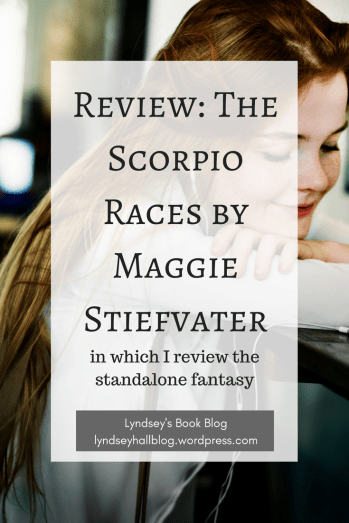
Have you read The Scorpio Races? Did you love it? Tell me in the comments, I must know! And, how perfect is this image? She reminds me so much of Puck 🙂
Lyndsey
x
I am a member of the Book Depository affiliate program, so if you click through and buy any of the books mentioned in this blog I might make a little commission, but I am not paid to review books and all reviews are my own opinions!


 Lyndsey Hall | Author